
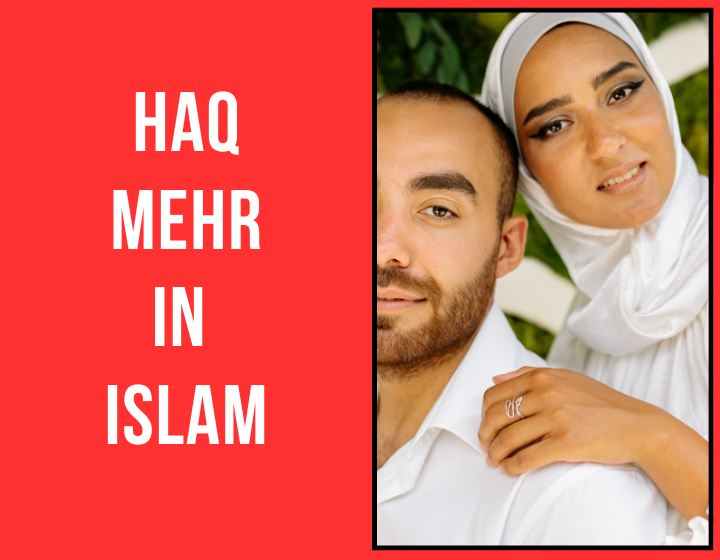
Haq Mehr in Islam: A Right, a Responsibility, and a Foundation for a Just Society
Haq Mehr in Islam: Haq Mehr (Mahr) is one of the most important rights given to a woman in Islam at the time of marriage. It is not a gift, not a favor, and not a cultural formality. It is a mandatory financial right that becomes the property of the wife as soon as the Nikah is performed.
Islamic Perspective on Haq Mehr
In the Holy Qur’an, Allah clearly commands:
“And give the women their dower as a free gift…”
(Surah An-Nisa 4:4)
This verse shows that Mahr is an obligation upon the husband. It must be given willingly and respectfully. It is not a price of marriage, but a symbol of honor, commitment, and responsibility.
The Prophet Muhammad ﷺ also emphasized the importance of Mahr. In many Ahadith, he encouraged simple and easy marriages. He said:
“The best marriage is the one that is easiest (and least burdensome).”
(Reported in Ibn Hibban)
This teaches us two key principles:
- Mahr must be given.
- It should not become a burden that delays or complicates marriage.
Islam allows flexibility in the amount of Mahr. It can be money, gold, property, or anything valuable agreed upon by both parties. Even teaching Qur’an has been accepted as Mahr in a well-known Hadith (Sahih Bukhari).
Haq Mehr Under Pakistani Law
In Pakistan, Haq Mehr is legally recognized and protected. It is mentioned in the Nikah Nama (marriage contract) and becomes a legally enforceable right of the wife.
Under the Muslim Family Laws Ordinance, 1961:
- The amount of Mahr must be clearly written in the Nikah Nama.
- It can be prompt (payable immediately) or deferred (payable later).
- If the husband fails to pay, the wife has the legal right to claim it through the Family Court.
- In case of divorce, unpaid Mahr becomes immediately payable.
This legal structure ensures that Haq Mehr is not just a religious concept, but also a protected financial right under state law.

Haq Mehr and Human Rights
From a human rights perspective, Haq Mehr strengthens women’s financial security and dignity. It:
- Recognizes a woman’s independent financial status.
- Provides economic protection, especially in case of divorce or widowhood.
- Encourages responsible behavior from the husband.
In a society where women may face financial vulnerability, Mahr acts as a built-in safeguard. It promotes fairness, accountability, and respect within marriage.
When properly understood and implemented, Haq Mehr supports the broader goals of human rights:
- Equality before the law
- Financial justice
- Protection of women’s rights
- Social stability
Building a Positive Society Through Proper Understanding
Many social problems arise not from Islamic teachings, but from cultural misunderstandings. Some people either demand extremely high Mahr for status, or treat it as a meaningless formality. Both approaches go against the spirit of Islam.
A balanced approach is needed:
- The amount should be reasonable and mutually agreed.
- It should be written clearly in the Nikah Nama.
- It should be paid honestly and on time.
- Families should avoid turning it into a show of wealth.
When Haq Mehr is treated as a serious right and a moral responsibility, it builds trust between husband and wife. Trust creates strong families. Strong families create a stable and positive society.
Conclusion
Haq Mehr in Islam is a divine obligation, a legally protected right in Pakistan, and a powerful instrument for promoting justice and dignity within marriage. It safeguards a woman’s financial security, strengthens accountability in marital commitments, and supports the foundation of a balanced and respectful family structure.
When families understand its true purpose—free from cultural exaggeration or negligence—Haq Mehr contributes to trust, stability, and long-term harmony. Such values are essential for building a responsible and positive society grounded in both Islamic principles and human rights.
For individuals and families seeking a trustworthy platform to find a compatible life partner while respecting Islamic guidelines and legal requirements, Rishta Connect provides a structured and professional online rishta web service. It is designed to facilitate transparent profiles, clear marital intentions, and proper documentation—including Haq Mehr details—ensuring that relationships begin with clarity, dignity, and mutual understanding.
FAQ:
-
What is Haq Mehr (Mahr) in Islam?
Many users ask what Haq Mehr actually means. In Islamic terminology, Haq Mehr is the mandatory right of a wife which the husband must promise at the time of Nikah. It is considered the wife’s exclusive property and honor given to her by the husband.
-
When and how should Haq Mehr be paid?
There is frequent confusion about timing and method of payment. Islamic jurisprudence allows the Mehr to be paid immediately at Nikah (mu’ajjal) or deferred to a later agreed date (muwajjal). If no payment time is specified, the wife can demand it at any time.
-
Can Haq Mehr be demanded at any time after marriage?
This is a common legal query. In Pakistan, the Supreme Court has ruled that if the Nikah Nama does not fix a timeframe, the wife has the right to demand Haq Mehr at any time — even years after marriage. Failure to pay can lead to legal action.
-
Is Haq Mehr paid in case of Khula (woman-initiated divorce)?
People often ask about Haq Mehr when divorce is initiated by the wife (Khula). Some legal interpretations in Pakistan hold that a woman seeking Khula may forfeit the right to claim Haq Mehr. Court interpretations vary, so precise legal advice is recommended.
-
Is there a fixed amount for Haq Mehr?
Another common question revolves around whether Islam fixes a standard amount. Islamic scholars say there’s no fixed maximum, but there is a minimum set by Shariah (equivalent to a specified value of silver). The amount should be agreed mutually by both parties — not imposed as a burden or status symbol.
